

The difference between a comment and a conversation
Often, the comment left after an NPS score isn’t enough to understand the motivations behind it.
Every NPS survey includes a comment field after the score. But since that field is optional, many people don’t answer it, or when they do, they write very little, which doesn’t give us much to work with.
That’s why we built conversational NPS. The agent reads what the person wrote, and when the reason behind the score still isn’t clear, it asks again.
A recent case shows this well. Someone gave LinkedIn a score of 10. We asked why, and the answer was:
“Actually, my score is based on my experience with LinkedIn Premium.”
If this were a regular NPS survey, it would stop here, leaving very little: a high score, a product name, no context on why.
The agent replied:
“Got it, Premium is the big differentiator for you. Can you tell me about a specific moment or something that happened that really showed that value in practice?”
And the answer came back complete:
“I’d been unemployed for two months, and in two weeks I landed two job opportunities, plus made contact with a lot of people because I could send unlimited messages to the people I was interested in working with.”
Here's the print of the conversation in Portuguese:
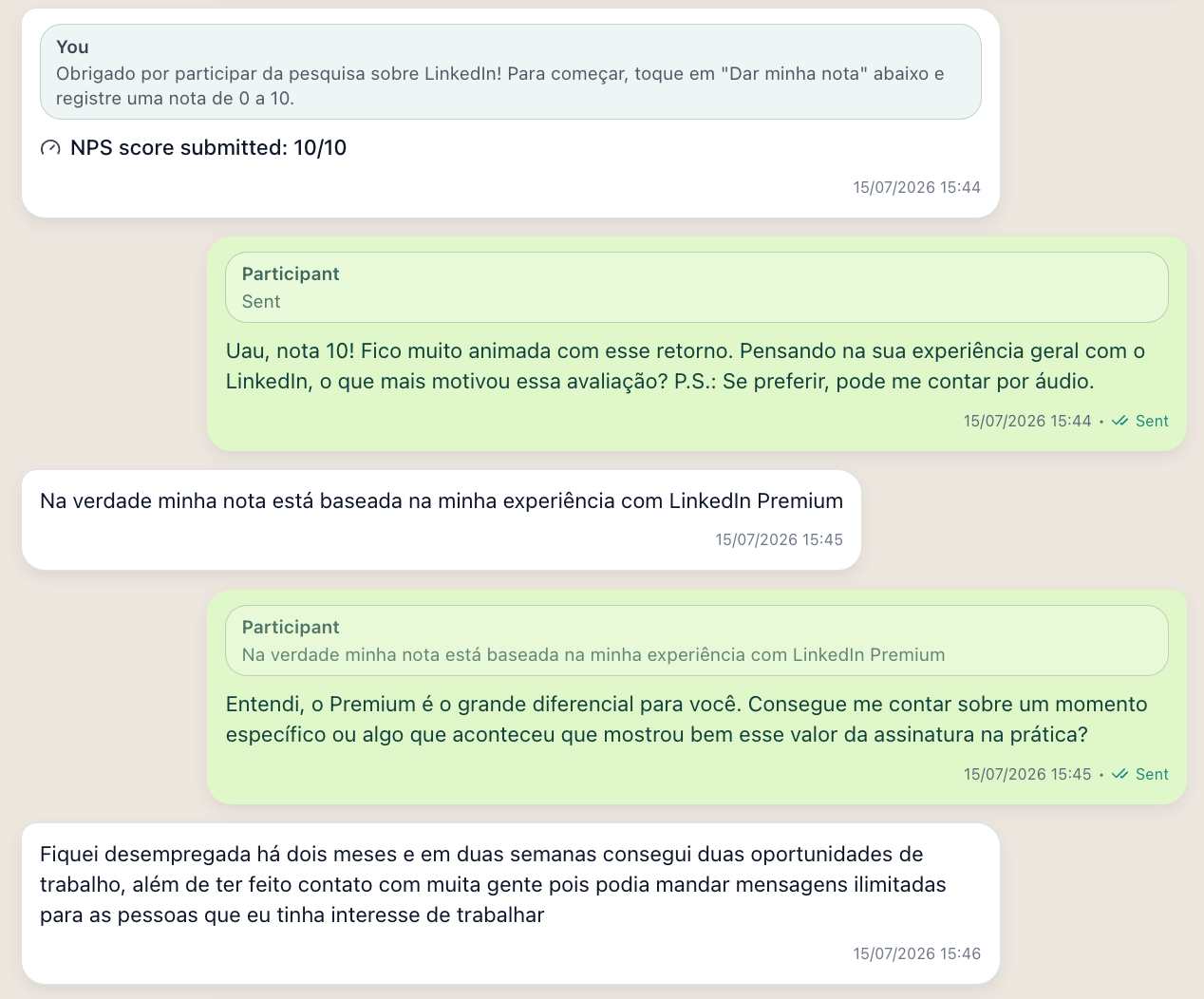
It translates into:
Wow, a 10! I’m really thrilled with that. Thinking about your overall experience with LinkedIn, what stood out most for you to give this score? P.S.: Feel free to send an audio message if you prefer.
“Actually, my score is based on my experience with LinkedIn Premium.”
Got it, Premium is the big differentiator for you. Can you tell me about a specific moment or something that happened that really showed that value in practice?
“I’d been unemployed for two months, and in two weeks I landed two job opportunities, plus made contact with a lot of people because I could send unlimited messages to the people I was interested in working with.”
That wasn’t in the first comment. It only came up because we asked a second time, asking for an example.
Asking for the reason makes the person summarize, and a summary turns into a label: Premium, the algorithm, the network. Asking for a moment makes the person remember, and remembering brings the whole scene back, who they were in it, what was at stake, what happened.
Data tells us what happened. Customers tell us why. And sometimes the why only shows up when we can go deeper, the way we do with Conversational NPS.
Book a demo to learn more about ReveLumi and Conversational NPS.