

NPS is the easiest metric to run and the hardest to actually use. Everyone sends the same question, 0 to 10, and gets a number back. The number tells you if things are going well or badly. It doesn’t tell you why.
The open text field in traditional NPS was supposed to solve that, but in practice it becomes a graveyard of one-line answers. “Good.” “Could be better.” “Not sure.” Nobody elaborates because nobody asks them to.
That’s why we built conversational NPS into ReveLumi. The person gives a score, and the agent talks with them to understand the why, actually digging in, not stopping at the first answer. To test it, we ran a survey about a product everyone has an opinion on: LinkedIn.
The number
133 responses. NPS of +7. 34% promoters, 39% passives, 27% detractors. Here’s the report building itself in real time as responses come in:
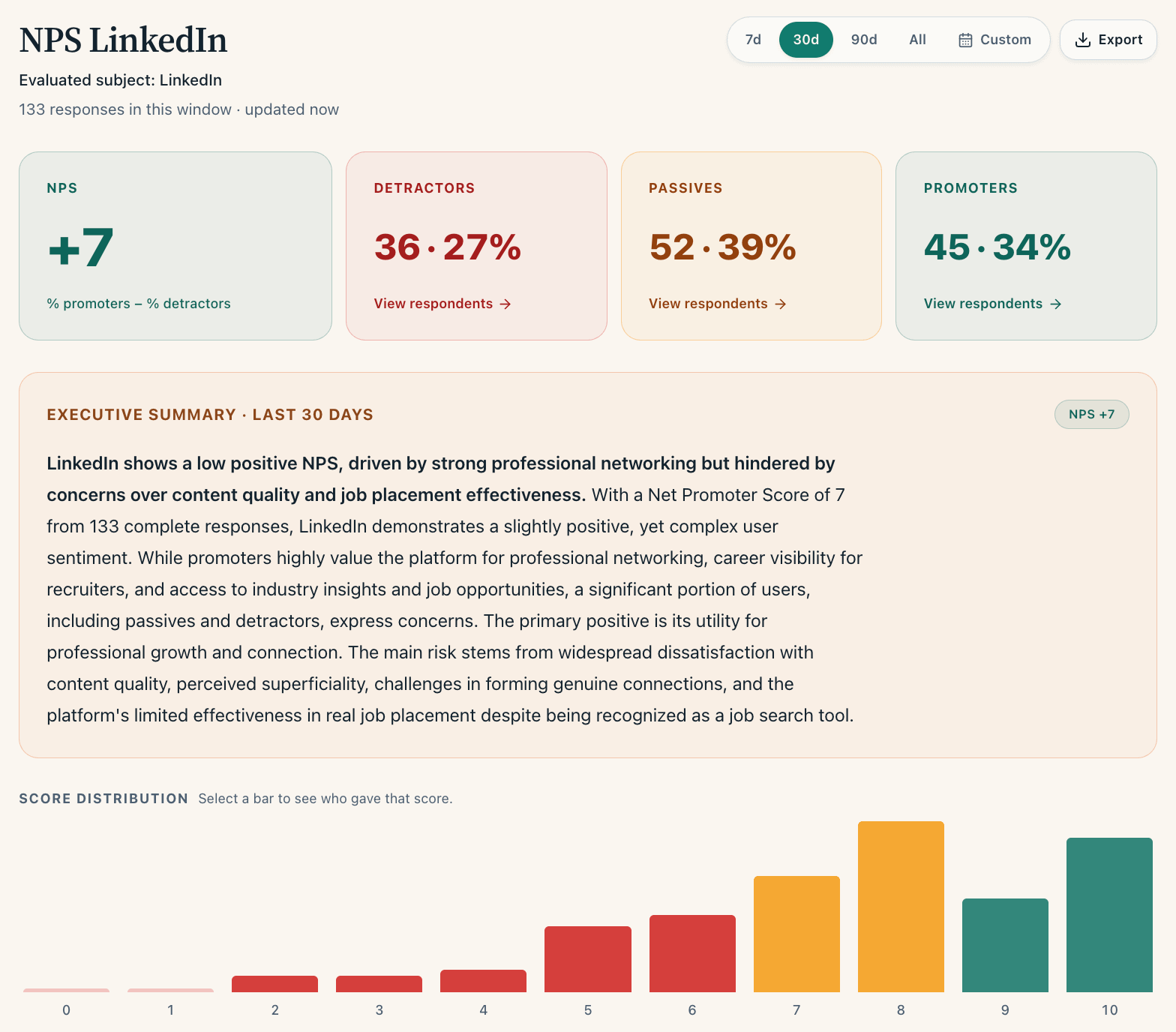
An NPS of +7, on its own, isn’t much. It says LinkedIn is more “tolerated” than “loved.” But that’s all it says. It doesn’t say what sustains the score, what brings it down, or what would change someone’s mind. That’s where the number stops and the conversation starts.
What sustains the score, and what brings it down
The biggest positive factor, by far, was professional networking: expanding your network, gaining visibility with recruiters, being found.
The biggest negative factor wasn’t price, or a bug, or the interface. It was content. Specifically: the feed being flooded with bots and AI-generated content, and right behind it, a term one respondent brought into the conversation herself:
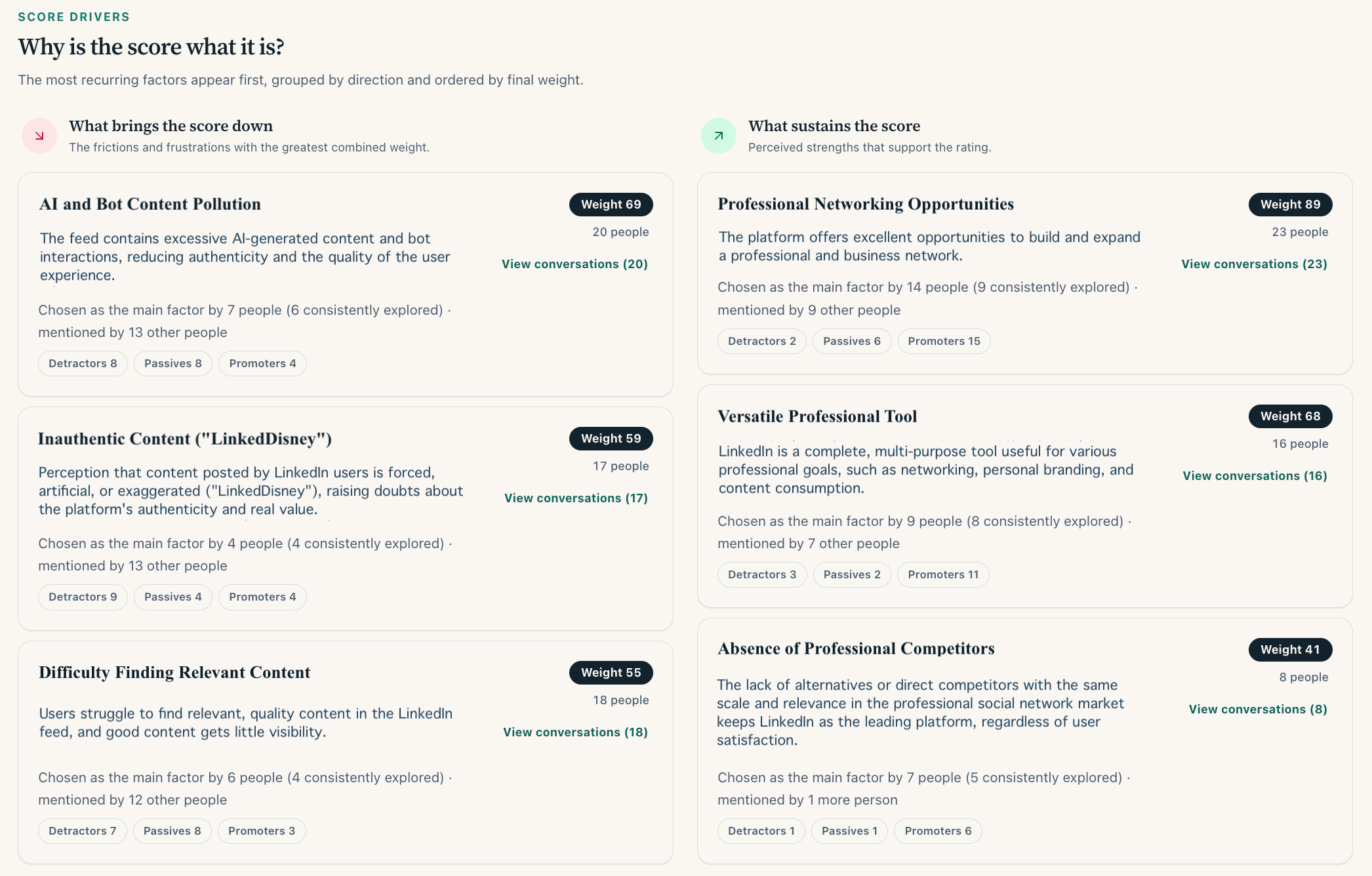
“There’s even a term for it, LinkedDisney. It’s because there are these very forced testimonials.”
LinkedDisney. A nickname already circulating among managers and directors to describe the feed’s performative exaggeration: overly dramatic stories, overly grand achievements, everything with a forced happy ending. No closed-ended question would ever land on that term, and no automated sentiment report would invent it. It only surfaces in a conversation, because someone needs to say, in their own words, what they actually feel. And the report doesn’t just capture the phrase, it weighs how much it contributes to the score, how many people touched on it, and links back to every original conversation.
The irony we didn’t plan for
We ran this survey with an AI agent. And the biggest villain the survey found was soulless AI-generated content.
It’s not a contradiction, it’s the distinction that matters most right now. There’s AI that produces empty volume, text that only exists to fill space and look productive. And there’s AI that listens, asks the follow-up question, and gives back real understanding. The difference isn’t in the technology. It’s in what it’s used for: generating more content, or generating more understanding.
Conversational NPS is a bet on the second one.
What the feature delivers
Instead of an open field most people ignore, the agent asks back, adapts the follow-up to the score (detractor, passive, promoter), and doesn’t let the person off with a shallow first answer. The result, as you saw above, isn’t just a number. It’s a map of factors, weighted and counted, linked to real conversations you can reopen anytime.
A traditional NPS would tell you: “+7, driven by networking.” Ours tells you that, and also hands you “LinkedDisney,” named by a real person, with enough weight to explain why the score isn’t higher.
Data tells us what happened. Customers tell us why. Now, with conversational NPS, the NPS tells us too.
See it for yourself: try LinkedIn’s NPS survey.
Want to test conversational NPS on your own product? Book a demo session with the founders.