

NPS became the standard because it’s simple: one question, one score, one number. But that simplicity comes with a cost that most companies feel and few name.
The problem isn’t the score, it’s what it hides.
Someone who gives a 0 and someone who gives a 6 fall into the same category: detractors. A 7 and an 8 are also treated as identical: passives. Two completely different experiences, reduced to the same label.
Add to that the comment field, which is optional. Most people leave it blank. Those who do write something usually write one line. “Good.” “Could be better.” You’re left with a number that already carries little information, and a comment too thin to fill the gap.
The result: you know whether things are going well or badly, but you rarely know why, and, as a consequence, what to do about it. It’s the most repeated criticism of NPS, and it’s a fair one. The number isn’t actionable on its own.
We felt this too
Since my time at Locaweb, we’ve run NPS surveys, and I always struggled with that lack of actionable information. It always frustrated me. Anderson and I ran NPS at Conta Azul with the same frustration.
That’s why we built Conversational NPS at ReveLumi. The question stays the same: on a scale of 0 to 10, how likely would you be to recommend this product or service to a friend? But after the score, the agent digs for what’s behind it. It asks, and asks again if needed, until the real reason comes through.
To show what that looks like, we ran an NPS survey about LinkedIn. Take a look at what we found.
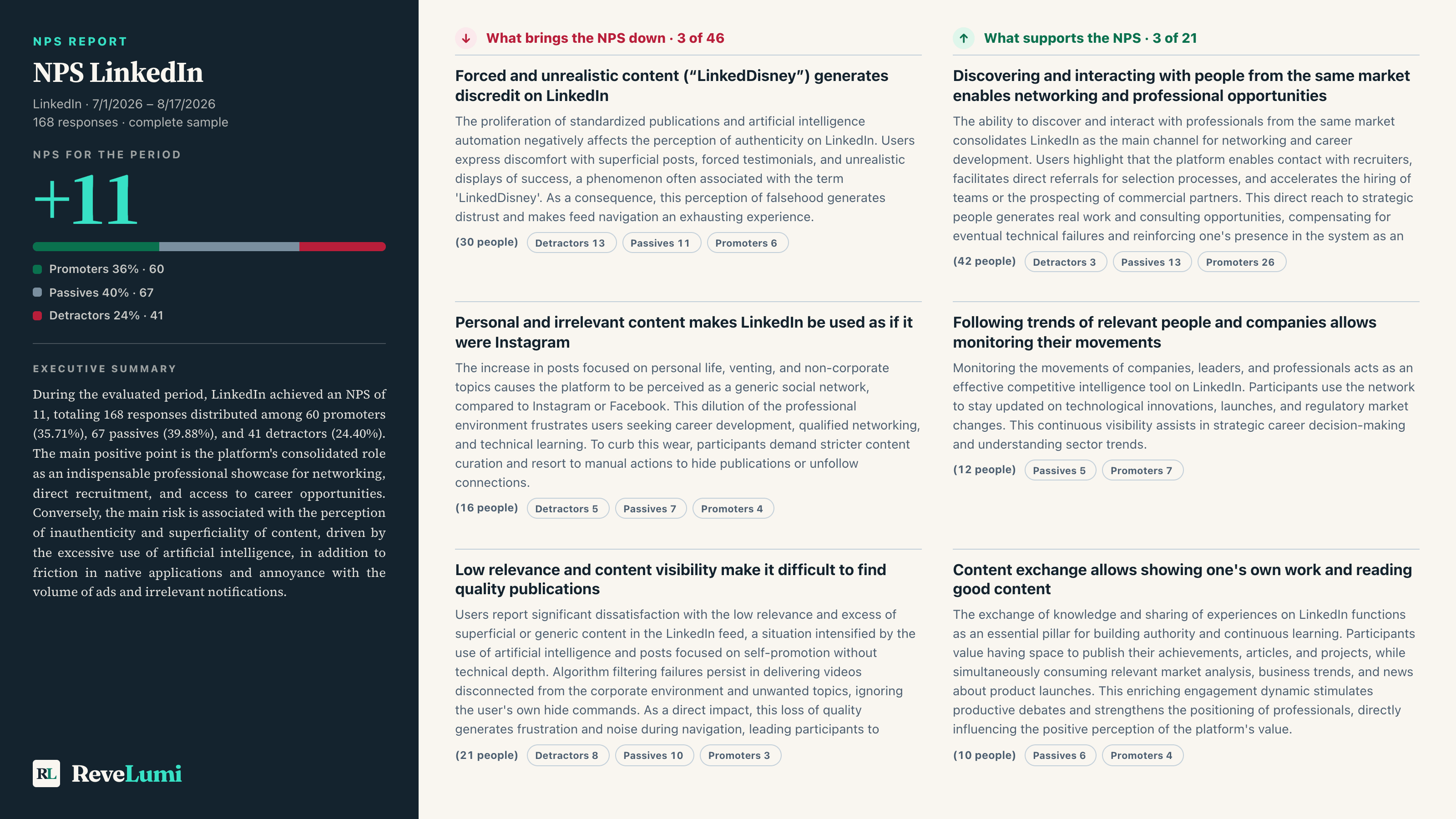
Try giving your own LinkedIn NPS score and experience being interviewed by our agent yourself.
Data tells us what happened. Customers tell us why.
NPS is still useful as a thermometer. What changes is what happens after the score. Instead of a blank field or a generic line, a conversation that gets to the bottom of the reason.
Book a demo to learn more about ReveLumi and Conversational NPS.